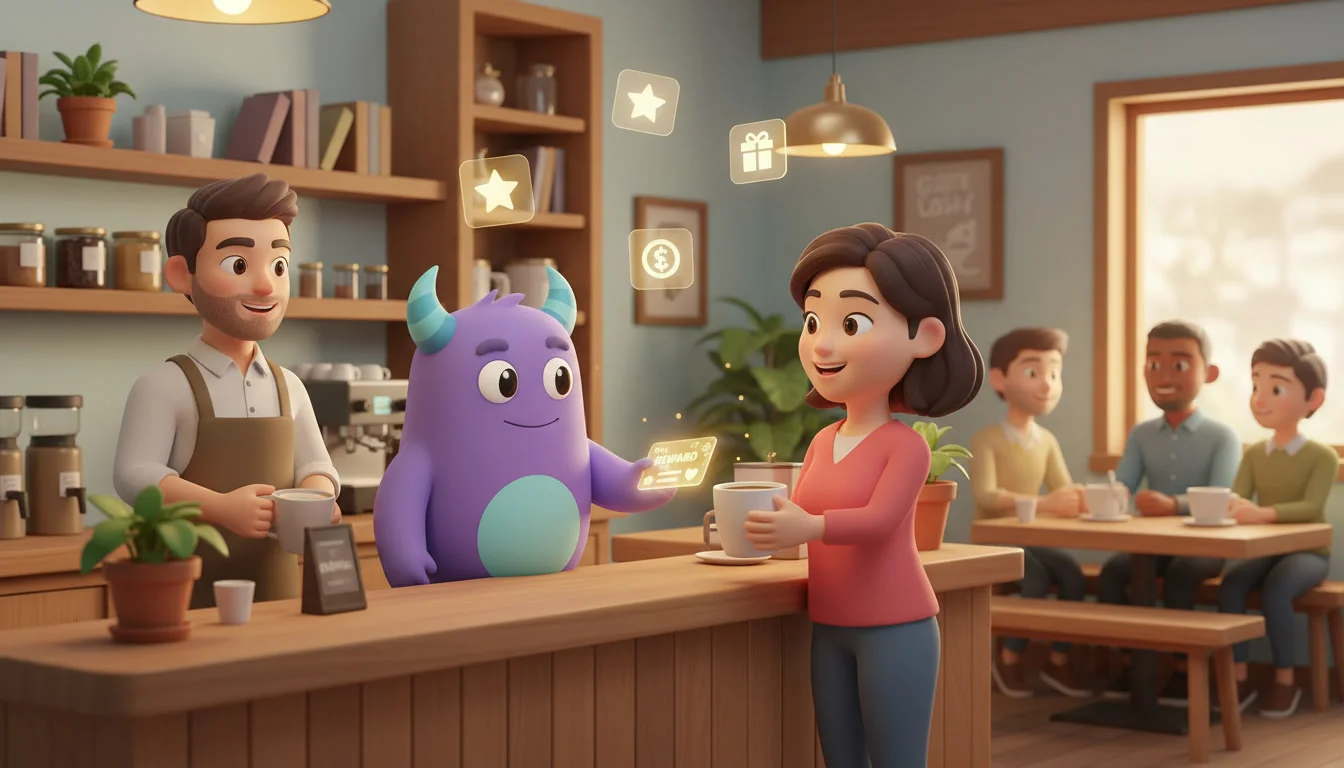

A loyalty points program rewards customers with points for purchases and other actions, which they can later exchange for discounts, free products or perks. Done well, it gives regular customers a clear reason to come back and gives you data about who your best customers are. This guide is for small business owners, marketers and customer teams in retail, hospitality, beauty, fitness and other service businesses who want to design a points program that is simple, affordable and easy to run from a CRM.
Key takeaways
- A loyalty points program works best when customers understand in seconds how to earn and how to redeem.
- Set the earn rate and reward value from your margins, not from what competitors seem to offer.
- Make the first reward reachable within a few visits, so new members experience a win early.
- Run the program from your CRM so points, purchases and messages sit on the same customer profile.
- Track redemption, repeat purchase rate and program cost to see whether the program pays off.
What is a loyalty points program?
A loyalty points program is a reward system where customers earn points for purchases or chosen actions, such as reviews or referrals, and redeem them for rewards. Points are stored on each customer's profile. The program encourages repeat purchases, rewards your best customers and collects data you can use for personalized offers.
Points programs compared with other loyalty models
Points are only one way to reward loyalty. Choose the model that fits your business and how often customers buy:
| Model | How it works | Best for | Watch out for |
|---|---|---|---|
| Points program | Customers earn points per purchase or action and redeem them for rewards | Businesses with frequent purchases and varied basket sizes | Points value must be clear and the reward easy to reach |
| Stamp card | One stamp per visit, a free item after a set number | Cafés, car washes, simple single-product purchases | Does not reward bigger spending |
| Tiered program | Customers move up levels with better benefits as they spend more | Brands with a group of high-value regulars | More complex to explain and manage |
| Cashback | A percentage of spend returned as store credit | Retail and e-commerce | Can feel like a plain discount |
| Paid membership | Customers pay a fee for ongoing perks | Businesses with strong repeat demand | Members must clearly get more value than they pay |
Many businesses start with a simple points program and later add tiers for their most loyal customers.
How to design your points program
Decide what earns points
Purchases are the core. You can also award points for actions that help your business, such as completing a profile, leaving a review, referring a friend or booking during quiet hours. Keep the list short so the program stays easy to explain.
Set the earn rate and reward value
Start from your margins. Decide how much of each sale you can afford to give back as rewards, then translate that into points. For example, you might give one point per unit of currency spent and set a reward at a points level that keeps the cost within your budget. Test the numbers on a few typical customers before launching.
Make the first reward reachable
If the first reward feels far away, many members never earn it. A welcome bonus on sign-up or a small first reward after a few visits helps new members feel progress quickly.
Choose rewards customers actually want
Discounts are simple, but free products, early access, priority booking or a small upgrade can feel more special and may cost you less. Ask regular customers what they would value.
Set clear rules
Write short terms: how points are earned, when they expire, what cannot be combined and what happens with returns. Clear rules prevent arguments at the counter.
How to launch a loyalty points program: step by step
- Define the goal. Decide whether you want more frequent visits, larger orders or more referrals, and pick one main metric.
- Choose the model and rules. Set what earns points, the earn rate, rewards and expiry.
- Set up customer profiles in your CRM. Add a points balance field and link every purchase to the customer.
- Create the sign-up flow. Let customers join at the counter, online or through a form, with clear consent for messages.
- Automate key messages. Welcome, points earned, reward unlocked and points about to expire.
- Train your team. Make sure staff can explain the program in one sentence and look up balances quickly.
- Launch to existing customers first. Invite regulars with a welcome bonus to build early momentum.
- Review after the first months. Check sign-ups, redemptions and repeat purchases, then adjust rewards.
Messages that keep members engaged
A points program only works if members remember it. Automated messages connected to each customer's balance keep the program visible without extra work.
Copyable loyalty message workflow
- On sign-up: "Welcome to [Program name], [Name]! You already have [X] bonus points. Earn [X] points for every [purchase/visit]."
- After a purchase: "You earned [X] points today. Your balance is [Y]. Only [Z] more to your next reward."
- Reward unlocked: "Great news, [Name]! You can now redeem [reward]. Just show this message on your next visit."
- Before points expire: "[X] of your points expire on [date]. Use them on [reward ideas] before then."
- Inactive member: "We miss you, [Name]. Your [Y] points are waiting. Come back this month and earn double points."
Send marketing messages only to customers who have agreed to receive them, and follow local privacy rules.
Use loyalty data to personalize offers
Points history shows who buys often, who spends more and who has gone quiet. Combine it with segmentation methods such as RFM analysis to send different offers to new members, loyal regulars and customers at risk of leaving. Members close to a reward can get a nudge, while high-value customers can be invited to an exclusive event or early access. To understand how much each customer is worth over time, see how to calculate customer lifetime value.
Common loyalty program mistakes
Rules that are too complicated
If staff cannot explain the program in one sentence, customers will not bother joining.
Rewards that are out of reach
When the first reward requires months of spending, most members give up early.
No follow-up communication
Customers forget their points unless you remind them. Silence turns a loyalty program into an unused card.
Not measuring the cost
Rewards cost money. Without tracking redemptions and repeat purchases, you cannot tell whether the program helps your profit.
Illustrative example: a café that turns visitors into regulars
This is a hypothetical scenario, not data from a real business or a guaranteed result.
Imagine a neighborhood café using paper stamp cards that customers often lose. After moving loyalty into a CRM, the café:
- Gives a welcome bonus on sign-up and points for every order.
- Sends a message when a free drink is unlocked.
- Reminds members a week before their points expire.
- Invites members who have not visited for a while back with a double-points week.
The owner now sees who the regulars are, how many rewards are redeemed and which members need a reason to come back.
How to do it in LUA CRM
Customer profiles with points
Keep contact details, purchases, points balance and loyalty history on one customer card.
Automations
Trigger welcome, points earned, reward unlocked and expiry messages automatically. Learn more about CRM automation.
Segments and campaigns
Build segments by points balance, last visit or spend and send each group the right offer.
Reports
Track members, redemptions and repeat purchases on dashboards.
Ready to reward your regulars? Try LUA CRM and set up your loyalty program.
Metrics to track
Member repeat purchase rate
Members who bought more than once in a period ÷ all active members in that period.
Redemption rate
Points redeemed ÷ points issued. Very low redemption can mean rewards are out of reach or forgotten.
Program cost
Total value of rewards redeemed plus running costs, compared with the extra revenue from members.
For more ways to keep customers, read these customer retention strategies.
Frequently asked questions
There is no universal number. Start from how much of each sale you can afford to return as rewards, then choose an earn rate and reward level that fit that budget and are easy to explain.
Many programs use expiry to limit long-term liability and encourage visits, but the rules should be clear and members should be reminded before points expire. Check local consumer rules too.
A stamp card is simpler and suits single-product purchases. A points program rewards bigger spending and gives you more flexibility with rewards and data.
Yes. A CRM can store points on customer profiles and send automated messages, so you can start without building your own app.
Compare repeat purchase rate and spending of members with non-members, and track redemptions and program cost over time.
Conclusion
A loyalty points program gives customers a simple reason to return and gives you a clearer view of who your best customers are. Keep the rules simple, make the first reward easy to reach, run everything from your CRM and review the numbers regularly so the program keeps paying for itself.