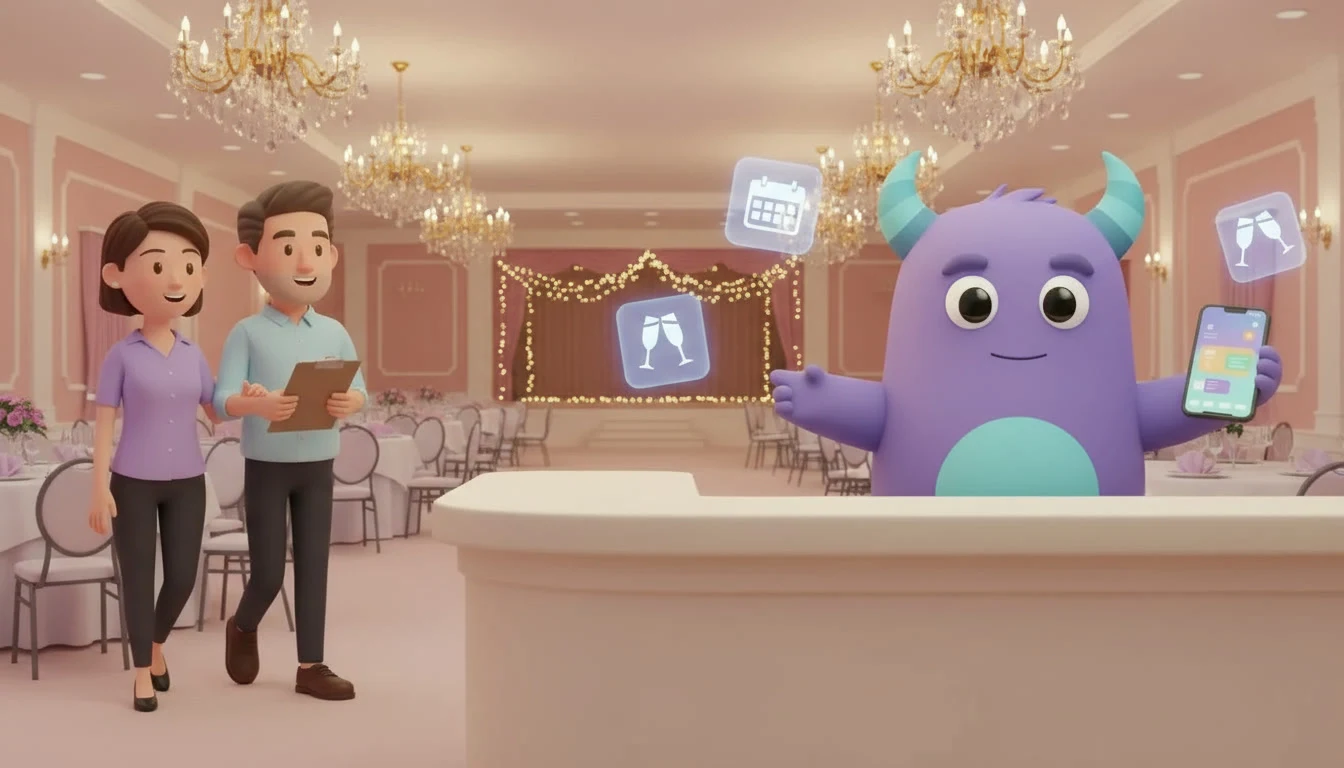

An event venue CRM keeps every inquiry, date hold, site visit, contract, deposit and event-day detail in one record per booking, so a banquet hall, wedding venue or conference center can fill its calendar without double-booking a room. Venues sell time and space. The same Saturday in June may be requested by five couples, a corporate client wants three rooms for two days and a planner asks for a tentative hold "just in case". This guide explains what a CRM for event venues should do, how to manage space availability and holds, and how to set one up step by step.
Key takeaways
- An event venue CRM starts from the space calendar: which room is free, held or booked on each date.
- Tentative holds need an expiry date and a clear first-option rule, or dates stay blocked for clients who never sign.
- Site visits are a sales stage with their own follow-up, not just a calendar entry.
- A banquet event order (BEO) gives the kitchen, setup crew and coordinator one version of the event.
- Deposits and final payments with due dates show which events are really confirmed.
What is an event venue CRM?
An event venue CRM is customer relationship management software set up for businesses that rent out event space: banquet halls, wedding venues, conference and meeting centers, restaurants with private rooms, rooftops and garden venues. It stores clients and their past events, inquiries, space bookings, contracts, payments and the operational details of each event.
It covers a different job from an event planner CRM, where a planner coordinates many vendors for one client, and from a catering CRM, where a caterer manages menus, tastings and delivery. A venue owns the space. Its main questions are: is the room free, who is holding it, has the client signed and paid, and is the team ready for the day?
Common problems in event venues
Double-booked rooms
The sales manager confirms a wedding in the main hall while a colleague promises the same date to a company dinner. One client has to be moved, and the venue's reputation suffers.
Holds that never end
A tentative hold is free for the client and costly for the venue. Without an expiry date, a popular Saturday stays blocked for weeks and other inquiries are turned away.
Event details scattered across messages
Guest count, floor plan, menu choices, AV needs and timings arrive by email, WhatsApp and phone. The kitchen and setup crew work from different versions.
Deposits chased at the last minute
If nobody tracks the deposit and the final balance, the venue only discovers an unpaid event a few days before it happens.
The venue sales pipeline
Most venue bookings follow the same path from first question to post-event follow-up. The table shows the stages and what to record at each one.
| Stage | What happens | What to record |
|---|---|---|
| Inquiry | A client asks about a date and a space | Event type, date options, guest count, budget, source |
| Tentative hold | A room is held without commitment | Room, date, hold expiry, first or second option |
| Site visit | The client tours the venue | Visit date, coordinator, rooms shown, questions |
| Proposal | Room hire, packages and menus are quoted | Quote version, package, minimum spend |
| Contract and deposit | The client signs and pays the deposit | Contract date, deposit amount, balance due date |
| Planning and BEO | Details are finalized | Final headcount, layout, menu, timings, suppliers |
| Event day and follow-up | The event runs and the client is thanked | Issues, extras charged, review request |
In Lua CRM, a project is a board of requests with stages you can rename, a default assignee and priorities, so each booking can move across stages like these. A request can point at a contact and later at a sale. A failure stage requires a reason, which shows whether dates are lost to price, availability or a competing venue.
Space availability and date holds
The space calendar is the heart of a venue CRM. Every room or area should have its own availability, and every hold and booking should be visible to the whole sales team.
- List your spaces with capacity by layout (theater, banquet, cocktail), so the right room is offered for each guest count.
- Use clear statuses such as available, first option, second option and confirmed.
- Give every hold an expiry date and remind the client before it ends.
- Offer the first-option client the chance to sign when a second inquiry arrives for the same date.
- Release expired holds the same day and move the request to a lost stage with a reason.
Lua CRM's Google Calendar integration syncs both ways, so holds and bookings can appear on a shared venue calendar. Project automations can react when a request enters or leaves a stage and create a reminder, change the responsible person, update a field or send an email or SMS, which covers hold-expiry reminders.
Site visits that convert
A site visit is often the moment a client decides. Treat it as a sales stage, not just an appointment.
- Confirm the visit the day before with the address, parking and the coordinator's name.
- Show the room set as close as possible to the client's event, and have photos of past setups ready.
- Write notes right after the visit: what the client liked, concerns and decision date.
- Send the proposal within a day while the venue is still fresh in their mind. Our quote follow-up guide gives a schedule for the next steps.
Banquet event orders and event-day coordination
A banquet event order, or BEO, is the single document that describes the event for every team: client and contact on the day, room and layout, timings, final headcount, menu and dietary requirements, beverages, AV and decoration, and suppliers arriving on site.
Keep the BEO on the booking, update it when the client changes something and share it with the kitchen and setup crew at a fixed deadline before the event. In Lua CRM, document templates support print, PDF and Word output and one template per language, and the features page lists a Document Builder with templates, so a BEO and a contract can be produced from the same booking. Tasks for the setup crew or AV technician can be created as tickets, and the Inspections module offers checklists with sections that can be used for a room-setup check before guests arrive.
Contracts, deposits and final payments
A date is only really booked when the contract is signed and the deposit has arrived. Set a standard rule, such as a deposit at signing and the balance a fixed number of days before the event, and track both.
In Lua CRM, confirming a sale with a contact and a total above zero creates the amount owed, with payment status Unpaid, Partial or Paid and a payment condition such as 1 week, 1 month or a custom date. The obligations report lists what clients owe, shows a Late badge once the due date is today or earlier and supports deposits (advances). Lua CRM also lists PayLink Armenia for sending secure payment links and collecting online payments.
How to set up an event venue CRM
- List your spaces and capacities. Every room, terrace and garden with its layouts and maximum guests.
- Build the booking pipeline. Create a project board with the stages from the table above and a failure stage with reasons.
- Add booking fields. Event type, date, room, guest count, hold expiry, package and budget.
- Connect your inquiry channels. Website forms, email, phone and chats. Lua CRM's omnichannel inbox covers WhatsApp Business, Telegram, Messenger and Instagram Direct, and Custom Forms create a contact and a ticket.
- Write your hold and deposit rules and add automation reminders for expiries and due dates.
- Prepare templates for the proposal, contract and BEO.
- Train the team to update the booking, not their own notes, after every client contact.
- Ask for reviews after each event. The review request automation guide shows how to time the request.
Metrics to track
- Space utilization: booked dates per room, especially peak days.
- Inquiry-to-visit and visit-to-contract rate.
- Hold conversion: share of tentative holds that become signed contracts.
- Lost reasons: price, availability, capacity or a competing venue.